
There is a version of the "college decision" that most people are painfully familiar with: you are 18 years old, your parents have opinions, your guidance counselor has a pamphlet, and somehow you are supposed to commit four years and $80,000 to a path you barely understand. For a lot of people, that decision didn't go perfectly.
The good news? It's 2026, and you get a second shot.
Online business degree programs have fundamentally changed who gets access to high-quality business education. Whether you are a warehouse supervisor who wants to move into operations management, a freelancer who wants the credential to land corporate contracts, or a recent graduate looking at an MBA before your career fully launches—the programs we cover in this guide are worth your serious attention.
This is not a list of every school that offers an online option. It is a curated breakdown of programs that consistently deliver on three things: accreditation that actually matters to employers, flexible formats designed for working adults, and outcomes that justify the price tag.
Important
Accreditation Check: Before enrolling in any online business program, verify that it holds regional accreditation AND ideally AACSB, ACBSP, or IACBE accreditation for the business school. Employers and graduate programs use these markers to assess the legitimacy of your degree. Unaccredited degrees are a complete waste of money regardless of cost.
---
What Makes an Online Business Degree Worth It in 2026?
Let's be direct about something: the credential market has gotten more competitive, not less. A bachelor's or master's degree in business from an obscure, unaccredited institution has approximately zero brand value in the job market. You need to be strategic.
Here's what the best programs share:
1. AACSB, ACBSP, or IACBE Accreditation
The Association to Advance Collegiate Schools of Business (AACSB) accredits fewer than 6% of business schools globally. When a program has it, employers know the curriculum, faculty credentials, and assessment standards have been rigorously validated. ACBSP and IACBE are excellent secondary accreditations, particularly for undergraduate-focused and career-oriented programs.
2. Asynchronous Flexibility
Working adults cannot attend live lectures at 2 PM on a Tuesday. The best online programs are primarily asynchronous—you watch lectures, submit assignments, and participate in discussions on your own schedule within weekly windows. Some programs require occasional weekend residencies or synchronous sessions; those details should be disclosed clearly before enrollment.
3. A Real Alumni and Career Network
This is where many online programs fall short. The hidden curriculum of an on-campus MBA is who you sit next to at lunch. Online programs that replicate this through regional alumni chapters, virtual networking events, and career placement offices are dramatically more valuable than those that simply hand you a diploma.
4. Transparent ROI Data
Any program worth attending will publish its employment outcomes: average salary increase, percentage of graduates employed within 90 days, and industry placement rates. If a school buries or refuses to disclose this data, that tells you something important.
---
Top Online Business Degree Programs in 2026 (Ranked by Category)
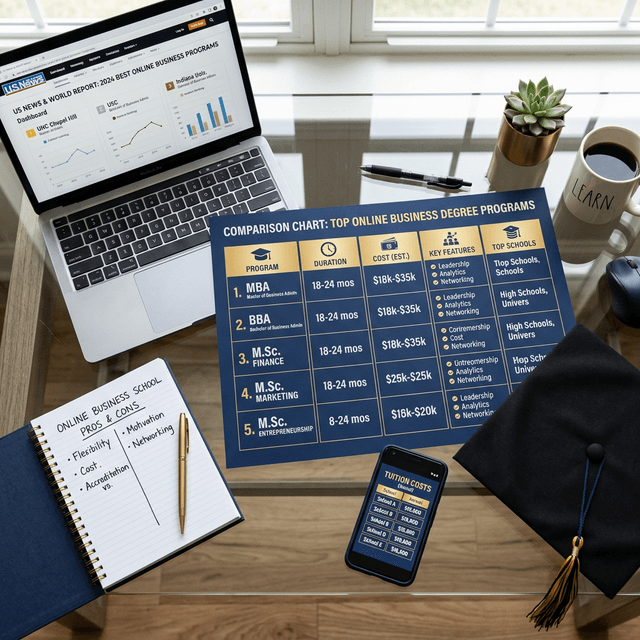
Online business degree program comparison showing top schools side by side with tuition costs and accreditation
Best Online MBA Programs
1. Indiana University Kelley Direct Online MBA
- Accreditation: AACSB
- Duration: 2–5 years (fully flexible)
- Tuition: ~$59,000 total
- Standout Feature: The Kelley Direct program is genuinely one of the most respected online MBA programs in the United States. It consistently appears in the top 20 of national rankings from US News & World Report, and employers recognize the Kelley name. The curriculum mirrors the on-campus program exactly—same faculty, same cases, same rigor. The program offers eleven specializations including Business Analytics, Finance, Marketing, and Supply Chain Management.
- Best for: Mid-career professionals who need a nationally recognized brand on their resume without relocating.
2. Carnegie Mellon University Tepper School of Business Online MBA
- Accreditation: AACSB
- Duration: 32 months
- Tuition: ~$98,000 total
- Standout Feature: CMU Tepper is for a specific type of student—one who wants to be at the intersection of technology and business leadership. The program leans heavily into data-driven management, machine learning applications in business, and quantitative strategy. If you are in tech, finance, or management consulting, the CMU name carries immediate credibility. The alumni network is deeply embedded in Silicon Valley and Wall Street.
- Best for: Tech professionals or engineers pivoting to senior management roles.
3. University of North Carolina Kenan-Flagler Online MBA
- Accreditation: AACSB
- Duration: 18–36 months
- Tuition: ~$62,000 total
- Standout Feature: MBA@UNC is built specifically for working professionals. The curriculum integrates real business simulations and live consulting projects with actual companies, giving you portfolio-worthy deliverables rather than just theory. The career services team actively supports students through job transitions, not just recent graduates. The program also offers a strong concentration in Entrepreneurship and Sustainable Enterprise.
- Best for: Professionals looking for strong project-based learning and active career support.
---
Best Online Bachelor of Business Administration (BBA) Programs
4. Arizona State University W. P. Carey School of Business (Online BBA)
- Accreditation: AACSB
- Duration: 4 years (120 credit hours)
- Tuition: ~$30,000–$43,000 total (in-state eligible via online)
- Standout Feature: ASU's online BBA is one of the most accessible elite-accredited programs in the country. Arizona State is ranked the #1 Most Innovative University in America (US News, 2025) and the online experience is designed with genuine instructional depth—not just a digitized textbook. The program has over 50 specialization pathways including Global Business, Real Estate, and Business Data Analytics. This is an excellent option if you are a working adult completing a degree for the first time.
- Best for: Working adults completing their first four-year degree on a budget.
5. Penn State World Campus (BBA, Bachelor of Science in Business)
- Accreditation: AACSB
- Duration: 4 years (120 credit hours)
- Tuition: ~$15,000–$24,000/year depending on credits
- Standout Feature: Penn State's reputation doesn't need a lengthy introduction. The World Campus online business degree carries the same accreditation and faculty as the main campus, and the degree certificate reads identically. Penn State has one of the largest alumni networks in the world—1.75 million members—which translates into real employment opportunity in any major U.S. metropolitan area. The program offers specializations in Finance, Marketing, Accounting, and Management.
- Best for: Students who want Ivy League-adjacent brand value without the Ivy League price.
---
Best Online MBA Specializations (Focused Programs)
6. Babson College Online MBA (Entrepreneurship Focus)
- Accreditation: AACSB
- Duration: 24 months
- Tuition: ~$73,000 total
- Standout Feature: If you are starting or scaling a business, Babson is in a different category. It has been ranked the #1 school in the world for Entrepreneurship by US News for over 25 consecutive years. The online MBA is built entirely around the Entrepreneurial Thought and Action (ETA) methodology. Every course is connected to practical business-building skills: market validation, venture finance, growth strategy, and leadership in ambiguous environments. The alumni network has an astonishing density of successful entrepreneurs. This is not a general management degree—it's a launchpad for founders.
- Best for: Aspiring or current entrepreneurs and small business owners.
7. USC Marshall School of Business Online MBA (Finance & Accounting Track)
- Accreditation: AACSB
- Duration: 21 months (accelerated) to 4 years (part-time)
- Tuition: ~$115,000 total
- Standout Feature: USC Marshall is one of the few online MBA programs with direct pipelines into investment banking, private equity, and corporate finance at major Los Angeles-headquartered companies. The Finance and Accounting specialization is taught by faculty who are also active practitioners. The alumni community in Southern California, New York, and increasingly in Asia is exceptionally active and career-engaged.
- Best for: Finance professionals targeting senior roles in investment banking, VC, or corporate strategy.
---
Best Affordable Online Business Degree Programs
Cost is real. Graduate school in the United States has outpaced inflation for decades, and the debt burden from an overpriced MBA can eliminate the ROI of the degree entirely. These programs deliver substantial value at a price that actually makes financial sense.
8. University of Texas at Dallas Naveen Jindal School of Management (Online MBA)
- Accreditation: AACSB
- Duration: 2–5 years
- Tuition: ~$26,000–$32,000 total
- Standout Feature: For sheer value, the UT Dallas online MBA is hard to beat. AACSB-accredited, with faculty who are published researchers in their fields, the program consistently places graduates into Dallas-Fort Worth's booming financial services, tech, energy, and healthcare sectors. At roughly a third of the cost of elite private programs, the ROI is mathematically compelling. The program offers concentrations in Finance, Marketing, Supply Chain, and Healthcare Management.
- Best for: Cost-conscious students targeting careers in Texas or the broader Sun Belt market.
9. Louisiana State University (Online MBA)
- Accreditation: AACSB
- Duration: 1–5 years (extremely flexible pacing)
- Tuition: ~$20,000–$28,000 total
- Standout Feature: LSU's online MBA is one of the most budget-friendly AACSB programs in the South. The program accepts students on a rolling basis (no GMAT required for qualified applicants), making it more accessible for career changers. The curriculum includes specializations in Marketing Analytics, International Business, and Finance. For students who need an affordable foot in the door and the credibility of AACSB accreditation, LSU is a serious option.
- Best for: Students seeking a fully accredited MBA at genuinely low cost.
---
How to Choose the Right Online Business Degree Program
Choosing a program isn't about picking the most famous school name and hoping for the best. It is a strategic decision that should be based on your specific goals, current situation, and financial reality. Here's a practical framework:
Step 1: Define Your Outcome First
What exact role or salary level are you targeting within three years of graduation? If you want to become a Chief Marketing Officer, a general MBA from any accredited program will serve you. If you want to move into investment banking, you need a specific program with proven placement records at banks. Work backward from the outcome.
Step 2: Verify Accreditation (Region + Business School)
Both layers matter. A school might have regional accreditation (university-wide) but the business school itself might lack AACSB/ACBSP/IACBE accreditation. Check both. The U.S. Department of Education Database of Accredited Postsecondary Institutions is the official verification source.
Step 3: Talk to Real Alumni
Every program has a polished website. The truth lives in the alumni experience. Use LinkedIn to find 5–10 graduates of your target program. Send personalized, respectful connection requests and ask about their experience, career outcomes, and whether they'd choose the program again. The responses (or lack thereof) are highly informative.
Step 4: Calculate the Real ROI
Use this formula:
- Expected Salary Increase (post-degree average salary minus current salary)
- Minus Total Program Cost (tuition + foregone income + fees)
- Divided by Total Investment
If the ROI doesn't turn positive within 4–5 years, you need to either reduce the cost of the program or increase your confidence in the salary outcome.
Step 5: Assess the Actual Time Commitment
An online degree sounds flexible until you realize "asynchronous" still means 15–20 hours per week. Be brutally honest about your current commitments—job, family, health—and choose a program pacing that you can actually sustain for 2–4 years without burning out.
---
Online Business Degrees vs. Traditional On-Campus Programs: A Honest Assessment
The "online vs. on-campus" debate in 2026 is less about quality and more about fit. Here is the reality:
| Factor | Online Programs | On-Campus Programs |
|---|---|---|
| Schedule Flexibility | High (asynchronous options) | Low (fixed class times) |
| Networking Depth | Moderate (virtual events, alumni chapters) | High (in-person, daily immersion) |
| Cost | Generally lower | Generally higher (housing, commuting) |
| Career Placement | Variable (program-dependent) | Often stronger for top-20 schools |
| Employer Perception | Rapidly improving; stigma nearly gone | Slight legacy prestige advantage |
| Geographic Mobility | Can enroll globally | Requires physical relocation |
| Learning Format | Self-paced, independent | More interactive, collaborative |
The stigma around online degrees has almost entirely collapsed—particularly for programs from AACSB-accredited institutions. In 2026, most HR departments screen for accreditation status, not delivery modality.
---
Backlinking Resources: Authoritative Sources for Research
When researching online business degree programs, consult these authoritative sources to verify rankings and data:
- US News & World Report Online Business Programs Ranking – The most widely cited ranking source for online business programs in the U.S.
- AACSB Business School Finder – Official database of all AACSB-accredited business schools worldwide.
- National Center for Education Statistics – Government source for verified tuition, enrollment, and completion rate data.
- Bureau of Labor Statistics Occupational Outlook – Use BLS data to verify salary projections for business roles you are targeting.
- Forbes Best Business Schools – Alternative ranking perspective with emphasis on ROI and salary outcomes.
---
Making the Most of Your Online Business Degree
Earning the degree is step one. Using the credential strategically is where most graduates either accelerate or stall. Here are four practices that separate high-performing degree earners from the rest:
1. Build Your Professional Presence While Enrolled
Don't wait until graduation to update your LinkedIn profile, start publishing insights in your area, or connect with your program's alumni network. The time you spend building professional visibility while actively studying is compounded—you can speak intelligently about coursework, projects, and frameworks while you're still learning them.
Use the AI Bio Generator to craft a compelling LinkedIn bio that reflects your in-progress credential and your career direction. A clear, purposeful bio doubles your connection acceptance rate in professional networking.
2. Document Your Academic Work Portfolio
Every case study, research paper, and strategy project you complete is portfolio evidence. Convert your best work into concise summaries that demonstrate analytical thinking and business acumen to future employers.
The Text Summarizer is invaluable here—use it to distill 25-page academic reports into sharp, 300-word executive summaries you can share as portfolio samples without overwhelming a recruiter's inbox.
3. Practice Executive-Level Communication
A business degree teaches you to think strategically. The degree itself will not automatically teach you how to write like a senior executive. Learning to communicate data-driven insights clearly and persuasively—in emails, reports, and presentations—is a skill that must be practiced deliberately.
Use the Paraphrasing Tool to review and refine your assignment writing before submission. The difference between dense academic prose and clear executive communication is often just a few deliberate reductions in jargon and sentence length.
4. Maintain Your GPA With Efficient Study Methods
Online programs require significant self-discipline. Students who thrive in asynchronous education typically have strong systems for reading comprehension, note synthesis, and exam preparation—not necessarily more innate intelligence than their peers.
Build an efficient study workflow:
- Use Flashcard Maker to convert textbook chapters into active recall review decks
- Use MCQ Generator to simulate business case exam formats
- Use Grammar Fix to ensure every submitted assignment reflects professional-level writing
For a complete system for studying effectively during an online degree, see our full guide: The Ultimate Guide to Automating Your Study Workflow with AI.
---
Frequently Misunderstood Facts About Online Business Degrees
"Online degrees don't count the same as in-person degrees."
This was true in 2010. It is not meaningfully true for accredited programs in 2026. A degree from Indiana University Kelley Direct is an Indiana University degree. Employers do not—and by law in many states, cannot—discriminate based on delivery modality for accredited programs. The brand and accreditation are what matter.
"You need a business undergraduate degree to get into an online MBA."
Most online MBA programs actively recruit students from non-business backgrounds—engineering, nursing, law, education. Many programs offer prerequisite bridge courses in accounting and statistics for non-business majors. Diverse academic backgrounds are often seen as an asset in MBA cohorts.
"Online programs have lower admission standards."
For the programs listed in this guide, this is false. Kelley Direct, Tepper, and USC Marshall have applicant pools that are as competitive as many of their on-campus counterparts. The shift to online has expanded access, not reduced standards.
"You won't make real connections in an online program."
This depends entirely on how proactively you engage. Students who attend virtual events, connect genuinely on LinkedIn, participate in regional alumni chapter events, and collaborate actively in group projects build real relationships. Passive attendance in online programs produces the same outcomes as passive attendance on-campus: shallow connections and missed opportunities.
---
Conclusion: The Best Time to Start Was Yesterday, the Second Best Is Today
The data is consistent across virtually every study on graduate education ROI: business degree holders—particularly those with MBAs from accredited institutions—out-earn their non-degree peers by substantial margins over the course of a career. The online delivery format has removed the two historically limiting barriers: geography and schedule.
You don't have to quit your job. You don't have to move to a new city. You don't have to pay $120,000 in tuition if your target outcome doesn't justify it.
What you do have to do is choose deliberately, verify rigorously, and engage actively. The programs in this guide provide the framework. The execution is yours.
---
Enhance your online degree journey with ToolNova's free academic tools:
* Text Summarizer – Condense lengthy academic readings into focused summaries instantly.
* Flashcard Maker – Convert your lecture notes into active recall study cards.
* Essay Writer – Build structured outlines for business case analyses and research papers.
* Grammar Fix – Ensure every academic submission reflects professional writing standards.
* Paraphrasing Tool – Refine your academic writing style and avoid unintentional plagiarism.