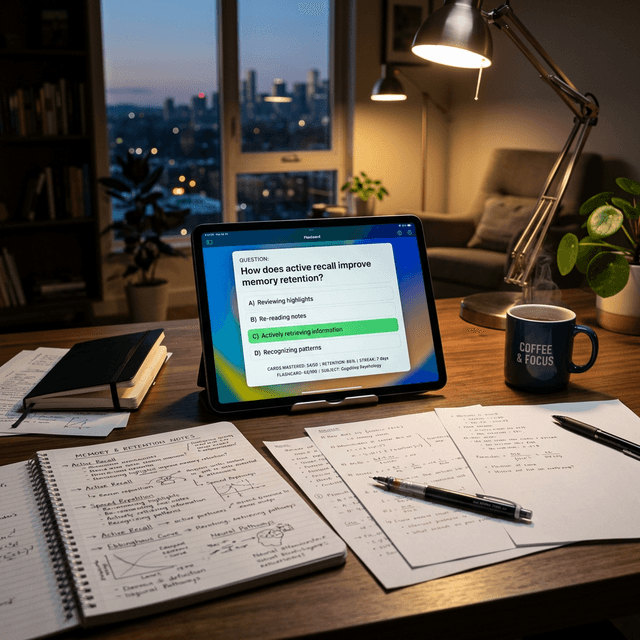
The great debate in every university library boils down to this: should you meticulously write out pages of color-coded notes, or should you spend hours creating decks of flashcards?
When tasked with memorizing entire semesters of medical terminology, historical timelines, or programming syntax, students often choose the method they find most visually appealing. But cognitive science doesn't care about aesthetics.
If your primary objective is long-term memory retention to conquer high-stakes exams, the science is conclusively settled: Flashcards fundamentally heavily outperform passive note-taking.
In this complete 2026 study guide, we will analyze the neuroscience behind why notes fail, why flashcards trigger deep encoding, and how to seamlessly combine both for the ultimate exam study workflow.
---
1. The Trap of Passive Note-Taking
We are inherently conditioned to believe that if we write something down beautifully, we will remember it. Note-taking, especially re-reading those same notes later, creates a deeply dangerous cognitive trap called the "Illusion of Competence."
When you stare at a page of your highlighted notes, your brain recognizes the information. Because the text feels *familiar*, you incorrectly assume you have *mastered* it.
The moment you walk into the exam hall and the notes are removed, the illusion shatters. Recognition is biologically shallow; recall is deep. Note-taking does absolutely nothing to test your ability to retrieve information independently.
While notes are spectacular for the initial phase of *comprehension* (understanding how a complex system works), they are mathematically terrible for *retention* (remembering the system 6 weeks later).
---
2. Why Flashcards Dominate Memory Retention
Flashcards force the brain to engage in the most powerful learning mechanism ever discovered by cognitive psychologists: Active Recall.
Forcing Cognitive Strain
When you look at the front of a flashcard (e.g.,"What is the function of the Golgi apparatus?"), your brain experiences friction. You are explicitly forcing your neural pathways to search for the answer without any external cues. That intense moment of friction physically strengthens the neural connection to the memory. The harder your brain works to retrieve the memory, the deeper it encodes it.
Enabling Spaced Repetition
Flashcards are modular, which makes them perfect for Spaced Repetition frameworks. You cannot logically"space repeat" a traditional 40-page notebook. But with digital flashcards, an algorithm can present you with the cards you struggle with every 2 days, while pushing the cards you know well out to 14 days, mathematically preventing the natural forgetting curve.
Instant Corrective Feedback
When you flip a flashcard, you get immediate confirmation of whether you were right or wrong. This rapid feedback loop corrects misconceptions instantly, whereas re-reading notes offers zero corrective feedback.
---
3. Creating Effective Flashcards (And Avoiding the Clutter)
The number one reason students give up on flashcards is the administrative nightmare of handwriting hundreds of them, followed by creating bad cards that are impossible to memorize.
Let AI Do the Administrative Typing
Never write a digital flashcard manually again. You can paste your entire chapter of raw notes or textbook summaries directly into an AI Flashcard Maker. The AI autonomously extracts the core definitions, processes, and historical dates to generate an intricate deck of 50 active-recall cards in three seconds.
The"One Fact Per Card" Rule
The deadliest mistake is writing a paragraph on the back of a flashcard. A flashcard must be atomic.
* *Bad Card:*"Explain the entire French Revolution."
* *Good Card:*"What year did the Storming of the Bastille occur?"
If a concept requires a paragraph to explain, break it into 5 distinct, separate flashcards.
---
4. The Ultimate Synthesized Study Protocol
Top-tier students do not randomly pick one camp over the other; they understand that notes and flashcards function as a strategic sequence. Follow this exact workflow to maximize both comprehension and retention:
- Phase 1: Ingestion & Comprehension. Read the textbook chapter and type out concise, logical notes. Use a Text Summarizer if the source material is overwhelmingly dense.
- Phase 2: Translation to Recall. Directly paste your organized notes into an AI Flashcard Maker to instantly digitize the data points.
- Phase 3: Deep Review. Spend exclusively 15 to 20 minutes a day actively reviewing your generated flashcard deck using app-based spaced repetition.
- Phase 4: Simulated Application. Every three days, synthesize your knowledge by simulating an exam. Use a Quiz Generator or an MCQ Generator to randomly test your holistic understanding of the chapter.
---
Conclusion
Abandon the false security of re-reading your highlighted notes. While note-taking remains an essential step for mapping out logical arguments, flashcards are the undisputed champion of burning facts into long-term memory. By leveraging modern AI generation tools, you can completely eliminate the busywork of creating study materials and spend 100% of your time dominating the active recall process.
---
Build your ultimate automated study workflow today with ToolNova:
* Flashcard Maker – Generate 50 active-recall flashcards from any document in 3 seconds.
* Quiz Generator – Simulate high-stakes exams to test your overarching comprehension.
* Revision Planner – Build a mathematically optimized countdown schedule for final exams.
* Notes Generator – Distill chaotic class lectures into clean, highly structured study sheets.
Need help rewriting or polishing your text?
Use ToolNova’s 100% free Paraphraser & Grammar Checker. No signup required.